Case study
Aviation Track winners, Agentic AI Build Week
An award-winning aviation maintenance platform that forecasts aircraft-tire wear, prioritizes interventions, and gives line engineers an agent grounded in fleet data and maintenance manuals.


The challenge
Aircraft tires wear by landings rather than calendar time, but maintenance teams often have to plan replacements from fixed intervals, scattered inspection records, and experience. A tire that reaches its limit unexpectedly can ground an aircraft, trigger emergency logistics, and leave the wrong spares at the wrong station.
SpartansE-V was built to turn routine tire inspections into an early, actionable maintenance plan without changing the limits defined by the Aircraft Maintenance Manual (AMM) or replacing mandated inspections.
What we built
The platform brings each aircraft and wheel into one decision-support workflow:
- It connects existing tread-depth, pressure, defect, and landing records—no new sensors are required.
- It forecasts a wear-to-limit window for every wheel, including tires with only a small number of readings.
- It ranks maintenance work by urgency and operational consequence.
- It compares predicted demand with station-level spare inventory.
- It uses computer vision to read tread depth, visible damage, and serial details from a tire photo.
- It gives engineers a conversational maintenance agent that checks forecasts, scans, dispatch rules, AMM limits, and spares before recommending an action.
Every recommendation remains grounded in the relevant source material so an engineer can inspect the reasoning instead of relying on an unexplained answer.
Product experience
The product is designed around the decisions line-maintenance and planning teams make every day: seeing fleet health at a glance, knowing what to replace first, moving spares before a shortage, and turning an approved recommendation into a work order. The same forecast supports the hangar floor and the planning office, giving both teams a shared view of risk.
Results
The public project results report validation on more than 1,000 tires, including 257 held-out tires from a pilot fleet:
- 3.8 days average error when predicting the wear-to-limit date 30 days out.
- 2× more accurate than standard machine-learning baselines late in tire life.
- 98%+ accuracy when reading messy free-text defect logs.
- ±0.23 mm tread-depth measurement from a single photo.
- Up to 43 landings of early warning, while keeping existing AMM removal limits unchanged.
The project won the Aviation Track at Agentic AI Build Week 2026 in Ho Chi Minh City.
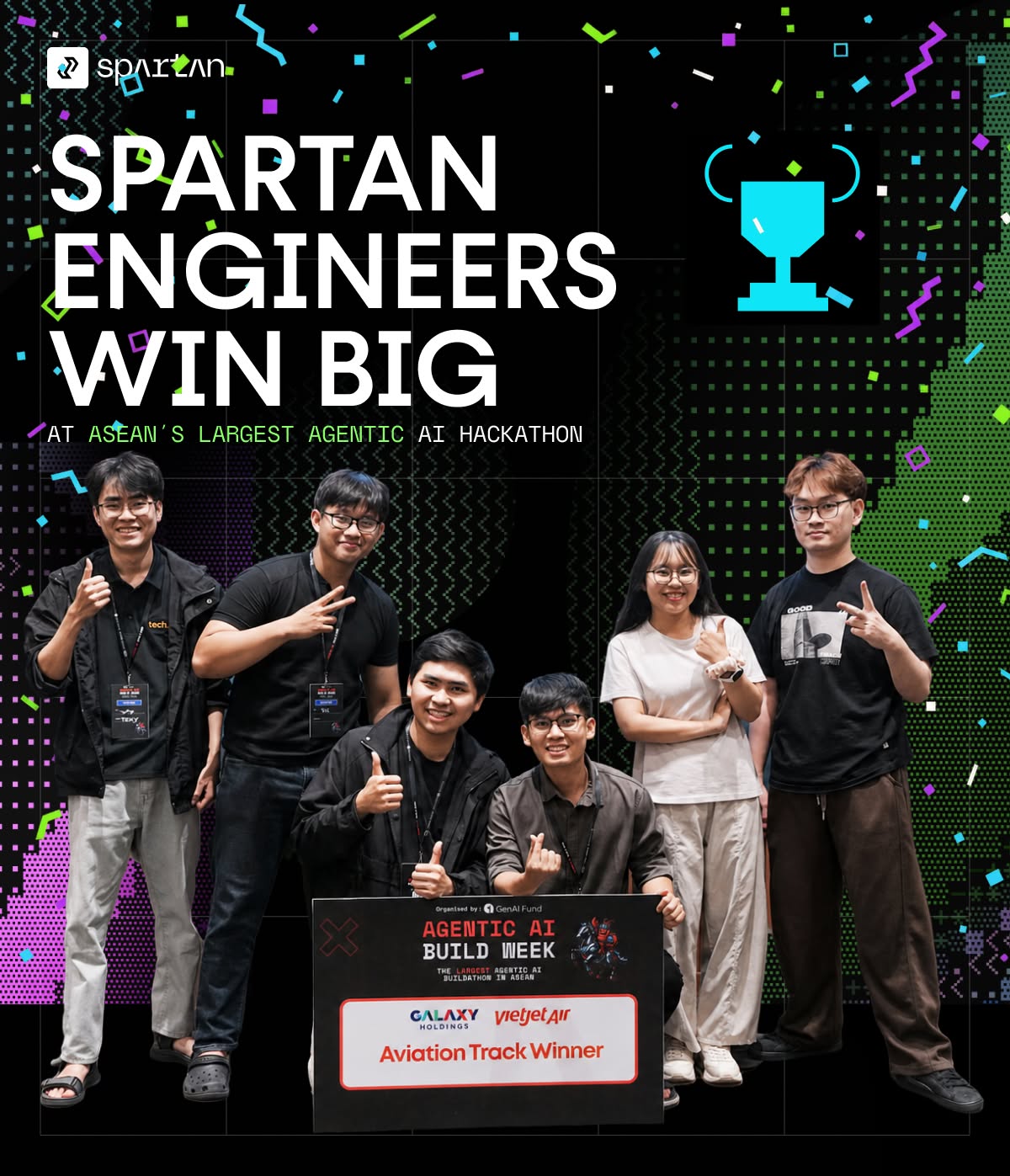
Team
SpartansE-V brought together six engineers across machine learning, computer vision, and aviation maintenance: Bạch Doãn Vương, Tú Nguyễn (Thompson), Trí Đoàn (TeeA), Trọng Trần (Alex), Thu Hoài (Yinn), and Nhân Nguyễn.
What I learned
In safety-sensitive workflows, a useful AI system does more than make an accurate prediction. It has to surface uncertainty, choose the cautious threshold, cite the governing maintenance rules, and fit the way engineers already inspect and schedule work.
Continue exploring
See all case studies ↗